勁 - Jing
on 勁 - on jìng / trained power (rather than 精 / jīng, essence ) | 丁國彪 - (Dīng Guóbiāo) (William Ting)
Jing – 勁 (jìn / jìng, trained power) - an inner power that is generated by unifying all the parts of the body allowing Qi - 氣 - breath to be used at its highest potential.
It is the twisting, circular, spiraling action of the body, both the outer physical movement and the subtle inner feeling of motion. The power of Jing relies on the body's ability to be Sung - 鬆 - sōng, relaxed / loosened.
Chan Ssu Jing – 纏絲勁 (chán sī jìn, silk-reeling energy) - the unbroken spiraling connection of the internal line from toes to fingers. The entire body is connected together so that "when one part of the body moves, every part moves together".
Fa Jing – 發勁 (fā jìn, issuing / explosive energy) - that is sudden and comes from the release of a flexible, whip-like motion striking out. The power originates from the earth, up through the feet, is controlled by the waist and hips and is expelled through the hands and feet.
Ting Jing – 聽勁 (tīng jìn, listening energy) - it is the ability to be sensitive and know the opponent, his movements and his changes.
Dong Jing – 懂勁 (dǒng jìn, understanding energy) - In the Tai Chi classic it is said, "If others do not move, do not move. If others move slightly, I move first." (from the classic writings attributed to Wu Yuxiang (武禹襄), and in the original reads: 彼不動,己不動;彼微動,己先動。) thus referring to the fulfillment of understanding. It is the ability to know both yourself and others, a total awareness that sees what is happening, where it is leading, and what to do about it. This skill is never achieved casually but is a product of intense study, practice and the accumulation of diverse experiences. At a high level, the practitioner returns to the state of no thought (無念 (wú niàn) or sometimes 無心 (wú xīn)- where mental perception and body reaction are one.
Jing – 「勁」(jìn / jìng、鍛えられた力)– 身体のあらゆる部分を一つに統合することによって生み出される内なる力であり、これによって Qi(「氣」、呼吸)を最大限に活かすことができる。
それは身体のねじれ、円を描き、螺旋を描く動きであり、外側の身体的な動きと、内側に感じられる微妙な動きの感覚の両方を含む。勁の力は、身体が Sung(「鬆」、sōng、緩み・ほぐれた状態)でいられるかどうかにかかっている。
Chan Ssu Jing – 「纏絲勁」(chán sī jìn、絹を繰る勁)– 足のつま先から手の指先まで、内なる線が途切れることなく螺旋状につながっていること。全身が一つにつながり、「身体の一部が動けば、すべての部分が共に動く」状態となる。
Fa Jing – 「發勁」(fā jìn、発する勁・爆発的な勁)– 突発的に生じ、しなやかな鞭のような動きが解き放たれて打ち出されることから生まれる勁。その力は大地に源を発し、足を通って上昇し、腰と股関節によって制御され、手と足から放たれる。
Ting Jing – 「聽勁」(tīng jìn、聴く勁)– 敏感に感じ取り、相手とその動き、その変化を知る能力である。
Dong Jing – 「懂勁」(dǒng jìn、理解の勁)– 太極拳の古典には、「相手が動かなければ、自分も動かない。相手がわずかに動けば、自分が先に動く。」と説かれている(武禹襄(Wu Yuxiang)の著作とされる古典より。原文は「彼不動,己不動;彼微動,己先動。」)。これは理解の完成を指している。それは自分と相手の両方を知る能力であり、今何が起きているのか、それがどこへ向かっているのか、そしてそれにどう対処すべきかを見通す、全き気づきである。この技能は決して安易に身につくものではなく、厳しい研究と修練、そして多様な経験の積み重ねによって得られるものである。高い段階に至ると、修行者は「無念」(wú niàn)、あるいは「無心」(wú xīn)の状態に立ち返る。そこでは心の知覚と身体の反応が一つとなっている。
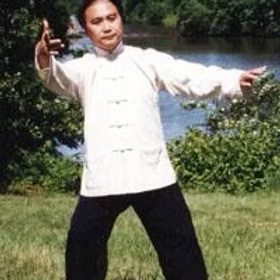
BAGUA XINGYI BAIPAN PALM
八卦掌 形意拳 八盘掌
Dong Haichuan Li Luoneng
董海川 李洛能
↓ ↓
Cheng Tinghua Guo Yunshen
程廷华 郭云深
↓ ↓
Zhao Qingchang Shen Wanlin Dong Hanqing
赵庆长 申万林 董汉清
↘ ↓ ↓
↘ ↓ Chen Pengwan
↘ ↓ 陈鹏万
→→→→→→→→→ Chen Jisheng ←←←←←←←←←←←←←←
陈济生
(1904–1988)
↓
Lü Jitang
吕继堂 (or 吕继唐)
(1918–2002)
↓
Ting Kuo-Piao (William Ting)
丁国彪 ?
(c.1950–2023)